
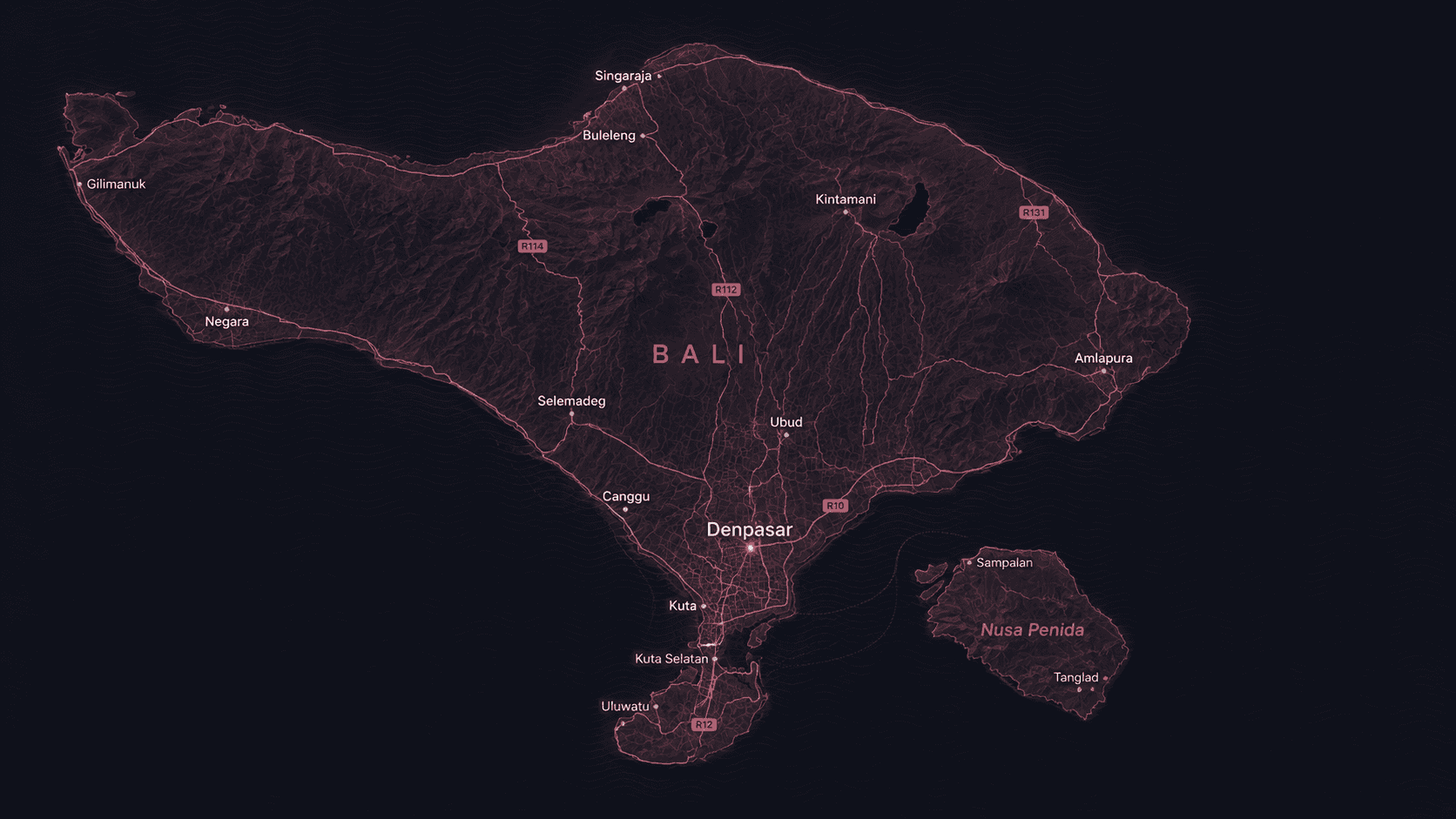
When we first arrived in Bali, I deliberately did not want to choose a neighbourhood in advance.
You can open dozens of guides and pretty quickly get a ready-made formula: Ubud for some people, Canggu for others, Bukit for someone else.
But I wanted to understand something different: where would we actually want to live?
So we rented our first villa for just six days and then gradually started moving around the island.
During that time, we managed to live in Bukit, Ubud, Seseh and Pererenan.
We also spent time in other parts of Bali:
📍 Kuta, Jimbaran, Uluwatu, Sanur, Nusa Dua.
But visiting somewhere for a few hours and actually living there for a normal week are still two different things.
So here I am only collecting what I have had time to experience myself.
This is not a final guide to Bali neighbourhoods and not a ranking from best to worst. It is simply my first conclusions after several moves and an attempt to understand just how different everyday life can feel on the same island.
At first, I thought the main thing was choosing the right area.
Now I understand that even that is not enough.
Two villas in the same neighbourhood can give you completely different experiences.
One is next to a busy road, while the other is a few turns away among rice fields. Both are five minutes from cafés, but you will wake up in completely different surroundings.
After moving several times, I started looking less at the name of the neighbourhood and more at what my normal day would actually look like from that exact spot.
Bukit. Our first introduction to the island
Our first villa was in Bukit, so for me, this will always be the first image of Bali.
An open kitchen, lots of air, our own outdoor space and the feeling that after living in an apartment, you suddenly have a yard again.
I really liked the possibility of spending most of the day outside instead of inside four walls.
We had breakfast outdoors, worked on our laptops there, listened to music, talked about the future, danced, cooked, and mostly went into the bedroom only to sleep or cool down when it got too hot.
But pretty quickly, I noticed the other side too.
If we are not talking about individual parts of the peninsula like Uluwatu, Jimbaran or Nusa Dua, but specifically about our everyday experience, I missed having connected infrastructure around the house.
You can rent a beautiful villa and then realise that for coffee, groceries, sport or even a normal dinner, you still need to go somewhere.
Bukit has many large roads, and there can be significant distances between individual places and residential areas.
This was where I first really understood one important thing:
Beautiful accommodation and a convenient life around it are not the same thing at all.
If I were choosing a house in Bukit now, I would definitely look not only at the villa itself, but at everything around it.
Where is the nearest decent supermarket? How long does it actually take to get to cafés and sport? What kind of road leads to the house? How easy is it to come back in the evening? What is on the neighbouring plots?
I liked Bukit itself.
It is just especially important here to understand which exact part of the peninsula you are choosing.
Ubud. Greenery, life around you and a lot of rain
After Bukit, we moved to Ubud, and the feeling of the island changed almost completely.
There is much more greenery here, plenty of places around, somewhere to go for breakfast, somewhere to spend the evening and things to do during the day.
I also liked the people around me.
I constantly saw sport, different practices, interesting projects, beautiful and passionate people.
Ubud has a very active daytime life, it is just completely different from the activity of the coastal areas.
But during the period when we lived there, there was a lot of rain.
The sky was often grey, everything felt damp, and after a while I caught myself thinking that I missed the sun.
One important thing: there is no ocean here.
That does not mean Ubud is always like this.
I can only talk about the period I experienced myself: out of two weeks, only four days were sunny.
But this was where I noticed how strongly the weather can change your perception of a place.
Sunny Ubud and several wet grey days in a row felt almost like two different places to me.
I would happily return again, but now I would understand that all that greenery and the cooler feeling of the area can also come with more humidity.
Seseh. The first place where I wanted to stay longer
After Ubud came Seseh, and this was the first place where I thought:
“I could actually live here for longer.”
It is noticeably calmer than the more active areas nearby.
There are lots of rice fields, homes surrounded by greenery, runners, athletes and multilingual young people who clearly did not just come here for a one-week holiday.
At the same time, I never felt like we had moved so far away that every normal everyday task turned into a separate trip.
And you can still get to the more active life around Canggu in roughly 15–20 minutes.
For me, this is exactly the scenario I had been trying to describe from the very beginning:
Close to civilisation, but quiet.
I especially liked that you can find a home near rice fields here without feeling completely cut off from normal life.
But Seseh has one important detail: construction.
The area is developing quickly, so for a long-term rental, I would look not only at the neighbouring house but also at the empty plots around you.
Today there may be a rice field next door, and a few months later a new project can easily start there.
Of the places where we have already lived, Seseh is still one of the areas I would genuinely consider for long-term living.
Pererenan. Closer to the action, but not inside it
Next came Pererenan.
For me, it turned out to be an interesting middle ground.
You can already feel more city life here: cafés, restaurants, sport, people and constant movement.
But at the same time, I did not feel like I was living right inside the busiest part of Canggu.
I like being able to get to everything I need quickly, but I do not want to live inside constant noise.
And this was where I understood even more clearly how important the exact street is.
One villa can be next to a road, while another is literally a few turns away in quiet greenery.
On the map, the difference looks small.
In everyday life, they can feel like completely different places.
What about Canggu, Sanur, Nusa Dua and other areas?
We have been there, and I already have first impressions.
Nusa Dua feels newer and well maintained, with wide spaces, less of that constant road chaos, places where you can walk or run comfortably, and hotels, restaurants and other leisure spots nearby.
I also want to return to Sanur, not just for a few hours, but to spend more time there and see what normal everyday life feels like.
We have also been to Kuta, Jimbaran and Uluwatu.
But for now, I do not want to present a short visit to an area as a full experience of living there.
If later we actually stay in one of these places or start spending more time there, I will simply update this article.
That is what I like about the idea of FROGI in Bali.
The map of the island does not appear fully formed from the beginning.
It gradually comes together along with our life here.
How I choose an area in Bali now
After several moves, I believe less and less in the universal formula of “this neighbourhood is for these people, that one is for others.”
Someone can love Canggu’s restaurants and sport but have no desire to live inside its traffic.
Someone can adore Ubud’s nature but struggle with humidity.
Someone can want to live near the ocean and then realise they are tired of getting on a scooter every time they need to buy something ordinary.
So now I would not start with:
“Which area in Bali is the best?”
I would start with:
How do I want my normal day to look?
First, I would understand how I plan to get around.
If you are not planning to ride a scooter or drive a car, distances start to matter in a completely different way.
What is convenient for someone on a scooter may be completely inconvenient without your own transport.
Then I would think about how important infrastructure near the house is.
Do you want to walk out for coffee? Do you need sport within a few minutes? Is it important to have a supermarket nearby? Or are you completely fine driving somewhere every time?
After our first few moves, this became one of the main questions for me.
Another separate question is what exactly I mean by quiet.
For one person, it means complete isolation.
For someone else, a house among rice fields.
And for someone, it is simply enough not to live next to a main road.
For me, the ideal now is a quiet house where cafés, shops and other civilisation are within 5–10 minutes.
The ocean
And then there is the ocean.
There is a big difference between:
“Sometimes I want to go to the beach”
and
“I want to be near the ocean almost every day.”
That immediately changes how important the location of your home becomes.
But my main test now is very simple.
I imagine not a holiday day, but an ordinary Tuesday.
Wake up. Have breakfast. Work. Go to training. Buy groceries. Meet someone. Come home.
If the location works well for exactly that kind of day, the chances that living there will feel comfortable become much higher.
In short
When we first arrived, I thought I was looking for a neighbourhood in Bali.
Now I think I am looking for a specific way of living.
Not just:
“I want to live in Pererenan.”
But:
“I want a quiet house, a decent road to get there, cafés and sport nearby, the ocean not too far away and no main road under my windows.”
And only after that does it make sense to look at which area can actually give you that scenario.
We are still living on the island, travelling around different parts of Bali and getting to know them gradually, so this article will keep changing along with our experience.
Read also
🏡 How we looked for accommodation in Bali
🛒 Where to buy groceries in Bali
🔐 Villa safety in Bali
📱 My set of apps for living in Bali
🏡 Where to look for accommodation in Bali: platforms, listings and long-term rentals — coming soon
Officially, I'm an editor of city media around the world. But really, I'm just that traveling frog who chases adventures, connects people, and discovers new ways to make life a little more meaningful, exciting, and full of wonder every day