
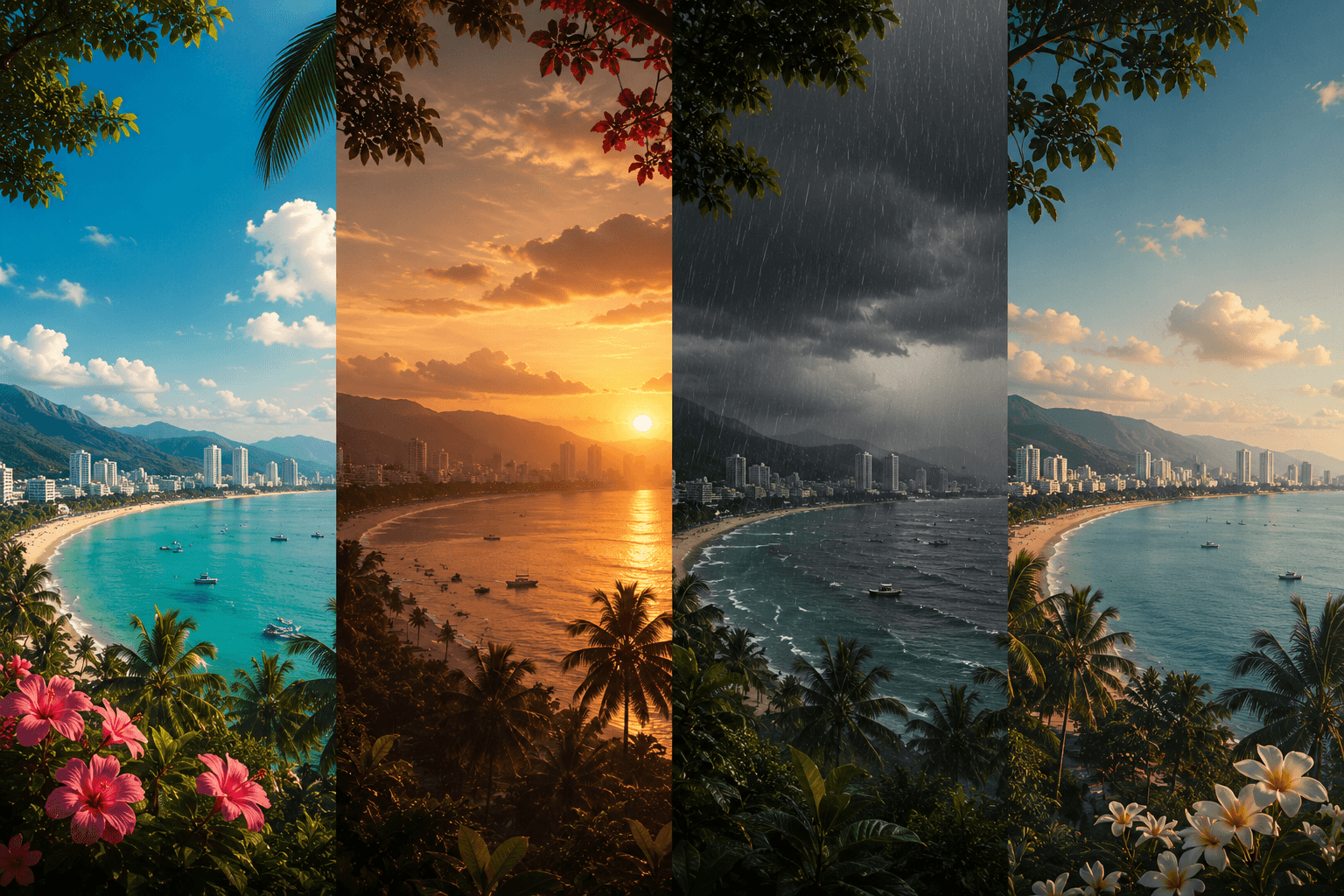
The question “when is the best time to go to Nha Trang?” sounds simple until you start asking:
what are you actually going there for?
To spend a week by the sea. To escape winter. To travel around Vietnam. Or to see Nha Trang as a city you could actually live in.
For each of these scenarios, I would choose a slightly different time. So looking for one universal “best month” is not really the right approach here.
🌦 What is the weather in Nha Trang actually like?
Nha Trang has two main seasons:
the dry season, roughly from January to August
and
the rainy season, from September to December.
According to the official tourism portal of Khanh Hoa Province, most rainfall falls during the autumn months, especially in October and November.
At the same time, Nha Trang remains a fairly sunny city, and even the rainy season does not mean it will pour nonstop for four months.
It can rain for a few hours. It can rain all day.
Or your weather app can show thunderstorms for an entire week while you are calmly sitting on the beach. So here, I would treat the forecast as a guideline rather than a timetable.
☀️ If you are travelling mainly for the sea
If your main goal is:
sea, beach, islands, and preferably not spending the whole holiday under an umbrella
I would look at the period from March to August.
In spring, the weather usually feels milder. March and April already have plenty of sunshine, but the heat is not yet as intense as in summer.
From June to August it gets hotter, but it is a good period for the sea and water activities.
The official Khanh Hoa tourism portal considers January to August the main sunny season, with June, July and August being the peak summer months.
🥵 If you do not handle heat well
I would be more cautious about May, June, July and August.
Nha Trang can be very hot during these months, especially in the middle of the day.
If your perfect day looks like:
“I leave the house at 11 a.m. and explore the city on foot until evening”
summer may have its own opinion about that plan.
During these months, life quickly starts revolving around air conditioning, the sea and one rule:
do everything important in the morning or closer to evening.
If you struggle with heat, I would look more towards the beginning of the year or spring.
🧳 If Nha Trang is only one stop on your trip
This is where things get more interesting.
Vietnam does not have one season for the entire country.
You can wake up in hot Nha Trang, arrive in Da Lat a few hours later and start looking for a sweater.
Meanwhile, the weather in northern Vietnam can be completely different again.
So if your route looks like:
Nha Trang → Da Lat → Da Nang → Hanoi → Sapa
do not pack based only on the Nha Trang forecast.
I would definitely bring:
- a light sweater;
- long trousers;
- trainers;
- something for the rain;
- at least one warmer outfit.
Especially if you are heading into mountainous areas.
Before a long route, check the weather for each region separately instead of simply searching “weather in Vietnam”.
🌧 What about the rainy season?
Around September, the weather starts to change.
The rainiest months are usually October and November, while the rainy season as a whole can continue through December.
But I would not automatically translate that as:
“You shouldn’t go to Nha Trang.”
The trip just becomes different.
The sea may be rougher. There are more cloudy days. Heavy rain can interfere with plans. Island trips become more dependent on the weather.
If you have seven days of holiday and dream of spending all seven by the sea, I would choose a more predictable season.
But if you are coming for several months, one rainy day does not feel like a tragedy anymore.
You can work. Eat pho. Go for a massage. Watch a movie.
And go back to the sea tomorrow.
🌴 If you are coming for the winter
Here, my opinion is a little different.
For long-term living, I actually really like Nha Trang from around mid-December onwards.
After the heavy summer heat, the city feels completely different.
Evenings become fresher.
- You can open the window.
- You can finally wear something other than a T-shirt and shorts.
- You can do your hair and believe, at least for a little while, that the humidity has not noticed.
For a two-week beach holiday, I would choose one season.
For several months of living here, I could easily choose another.
And this is exactly why the question “When is the best time to go?” cannot really be answered without a follow-up.
🏡 If you are thinking about moving
If you are not just coming for a holiday but want to understand whether you could live in Nha Trang long-term, I would deliberately spend at least part of your stay during a less-than-perfect season.
It sounds strange.
But it is easy to come only when the sea is blue, the sun is shining and the city is showing you its most beautiful side.
It is much more useful to see what happens to your potential home after several days of rain.
I would check:
- whether there is a damp smell;
- whether mould appears;
- whether the windows leak;
- how well the ventilation works;
- how humid the apartment feels;
- whether the street or courtyard floods;
- how noisy it is during heavy rain;
- whether there is enough natural light.
If you are choosing a place to live for several months or a year, these things can turn out to be more important than the view from the window.
This is just my personal approach, not a universal rule. If I were choosing an apartment for long-term living, I would want to see it in more than just perfect weather.
💸 There is another advantage to travelling outside the peak season
The city becomes calmer.
And when searching for long-term accommodation, it may be easier to view options without feeling like you need to decide immediately because:
“Someone will take it tomorrow.”
But housing prices depend on more than just the season.
They are influenced by the area, rental period, specific property, demand and even how well you negotiate.
So I would not build an entire move around the idea:
“I’ll come during the rainy season and everything will be cheap.”
That is not quite how it works.
📅 If we keep it very simple
January and February
A good option if you want more comfortable temperatures and not the most intense heat.
March and April
One of my favourite periods for a regular holiday.
Lots of sunshine, the sea, and not yet the peak of the summer heat.
May, June, July and August
Good for people who enjoy proper tropical summer.
Hot, sunny and a good period for the sea, but this is when we start taking sun protection very seriously.
September
A transitional month when the weather starts becoming less predictable.
October and November
The highest chance of rain.
The sea can be rough, so a beach holiday becomes much more dependent on the weather.
December
A transition towards a drier period.
For long-term living, I personally like this time more than the hottest season.
🤔 So when should you actually go?
- If your goal is a one- or two-week beach holiday, I would choose the period from March to August.
- If you do not handle heat well, I would look towards the beginning of the year and spring.
- If you are travelling around Vietnam, I would build the route first and only then choose the dates.
- If you want to spend the winter here, Nha Trang is worth considering from December and through the first months of the year.
- If you are planning to move, I would not try to see the city only from its perfect side.
Because a holiday lasts two weeks.
But if you live here, you will also have to experience an ordinary sunny Tuesday and a November downpour.
Do not look for the best season in general.
First ask yourself:
what exactly do you want from Nha Trang?
The sea every day. Comfortable temperatures. A big trip around Vietnam. Several months by the sea. Or a city where you might actually want to live.
Once you answer that, choosing the dates becomes much easier.
FAQ
Officially, I'm an editor of city media around the world. But really, I'm just that traveling frog who chases adventures, connects people, and discovers new ways to make life a little more meaningful, exciting, and full of wonder every day