And I felt like my world had become bigger 🚆
In Japan, trains can easily feel like just an ordinary part of everyday life.
In my hometown of Ena, high school students take local trains to school. In Tokyo, the railway network is so large that even a map of the lines can look intimidating at first. And the Shinkansen, Japan’s high-speed train, makes it possible to travel between major cities fairly quickly.
But I only took a train on my own for the first time when I was 15.
And it had nothing to do with simply wanting to go somewhere.
🦌 It all started with wanting to become a hunter
At the time, I was interested in becoming a hunter.
Through social media, I found a woman who worked as a hunter and also ran a restaurant serving game meat in Totsukawa Village, Nara Prefecture.
I contacted her myself and decided to visit so I could meet her and learn how to butcher a deer.
Totsukawa is located in the mountainous part of Nara, and there is no railway in the village itself.
My father drove me there. The journey took around four hours by car.
But I decided to make my own way home.
That was the first time in my life I took a train alone.
🚆 Why an ordinary train journey felt difficult to me
It was not the train itself that scared me.
For the first time, I had to figure out on my own where to go, where to board and how to eventually get home.
When you always travel with your parents or other adults, many things seem to happen automatically.
Someone knows the way, keeps track of the time and chooses the right route.
This time, the responsibility was mine for the first time.
I remember that before this trip, the railway made me nervous.
But once I managed to get home by myself, that feeling disappeared.
I felt as if my world had become bigger.
That is probably why I remember this journey so clearly.
🚉 A train in Japan can mean completely different kinds of journeys
Railways here can be part of an entirely ordinary day.
In Ena, for example, students use local trains to get to school, including the Akechi Line.
Tokyo looks completely different.
It has one of the largest and most complex railway networks, and passengers have to navigate between many different stations and lines.
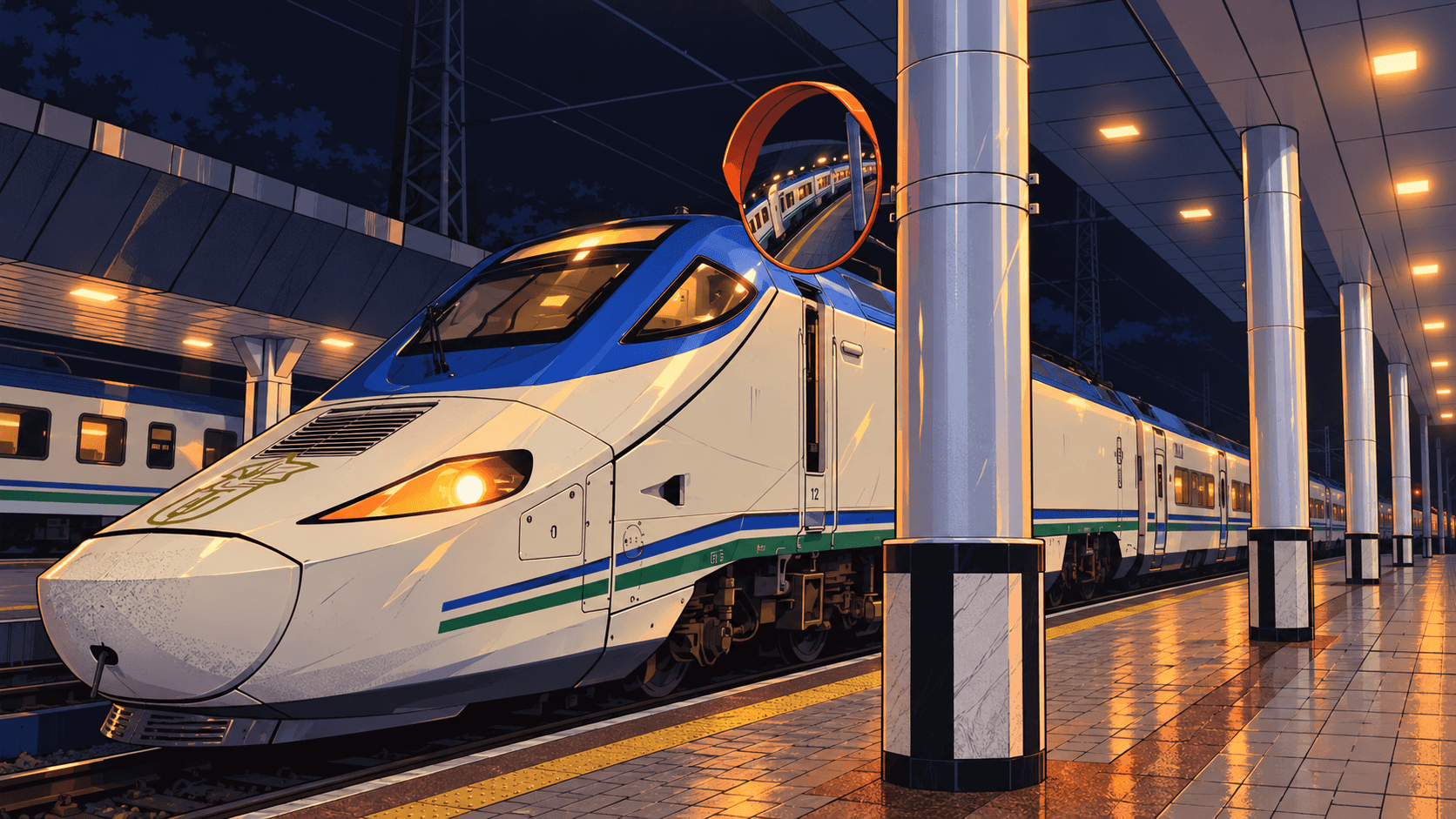
Then there is the Shinkansen, Japan’s high-speed railway connecting major cities.
For example, Hayato compared travelling between Tokyo and Nagoya.
By intercity bus, the journey can take around five to six hours, while by Shinkansen it takes roughly an hour and a half.
So the same idea of “taking a train” in Japan can mean a student’s everyday journey to school, part of a complicated route across Tokyo, or a way to reach another major city in a short amount of time.
📱 Figuring out a route is much easier now
For travelling around Japan, I recommend the Norikae Annai (乗換案内) app, a service for planning public transport routes.
You enter your departure station and destination, and the app shows suitable options, the fare, departure and arrival times.
You can choose:
- 早 — the fastest route;
- 安 — the cheapest;
- 楽 — the route with the fewest transfers.
The app can also show you the correct platform and suggest which carriage is best if you need to transfer later.
For someone using the Japanese railway system for the first time, small details like this can make the journey much easier.
🇯🇵 But understanding the route is not everything
Japanese transport also has its own rules of behaviour that are not always obvious to foreigners.
And there is an interesting detail here: according to Hayato, even Japanese people themselves can sometimes find it difficult to understand all the rules in their own country.
That is why we separately collected his view on what tourists actually need to know, how a cultural norm differs from breaking the law, and what to do when you simply do not understand what is expected in a particular situation.
👉 Even Japanese people find it difficult to understand all of Japan’s rules 🇯🇵
You do not need to memorise every rule before your trip.
Sometimes it is enough to know the basics and pay attention to how the people around you behave.
🌍 After that first independent journey, others followed
Later, there were many other journeys in my life.
I rode a motorcycle from Gifu to Fukuoka.
In Uzbekistan, I used the metro abroad on my own for the first time.
On another trip, I started talking with the owner of a ryokan, _a traditional Japanese inn_, and I still remember how warm I felt when he said goodbye with the words, “Come again.”
Each of these moments gave me a new experience.
But that first journey home on my own remained special, because it was the first time I realised how quickly your attitude towards something you used to fear can change.
🏔 You do not have to cross a border for that
I have already visited Uzbekistan and Thailand, and in the future I would like to see Russia and other countries of the former Soviet Union.
But distance does not determine the value of a journey for me.
Some of the experiences that affected me most happened inside Japan.
I still want to travel around my own country.
There are many prefectures I have never visited, and I am especially drawn to mountainous regions because I love mountains more than the sea.
And the more I travel, the less I see Japan as just a few famous cities.
In a separate article, I have already explained why old Japan, for me, does not end with Kyoto and why modern Japan is not limited to Tokyo.
👉 Not only Kyoto. Where to find old and modern Japan 🇯🇵
My world became bigger not because of the distance
When I was 15, I did not fly to another country or go on some huge journey.
I simply had to figure out for the first time how to get home by myself.
But after that trip, trains stopped frightening me.
And with that came the feeling that I could now go somewhere I would never have dared to go before.
That is probably why this story is still one of the most important ones for me.
My world became bigger not because the train took me far away. It became bigger because, for the first time, I realised I could find my own way home.
Hi! 👋 I show real life in the Japanese countryside and make vlogs about my everyday life 🇯🇵🏡 Follow along! ✨